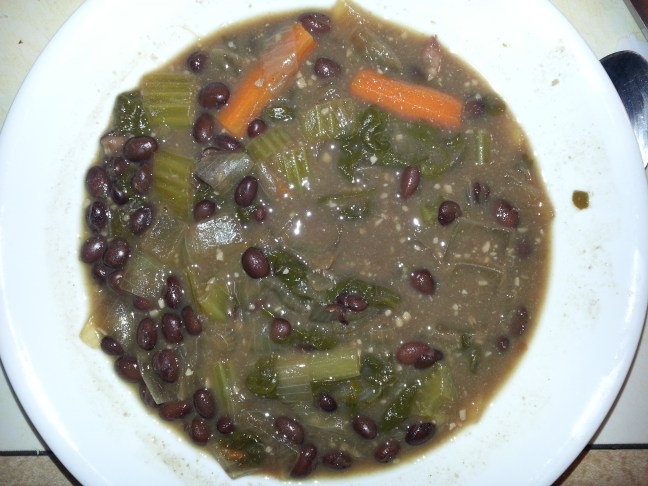
Black Bean Miso Stew

Ingredients

1.  4 tblspoons of Yellow Miso Paste

2.  4 carrots, cut into 2in segments

3.  3 stalks of celery, cut into 1in segments

4.  1 can of black beans, drained and rinsed

5.  2 tblspoons minced garlic

6.  1 tblspoon dried basil

7.  1 medium onion coarsely chopped

8.  1 cup of spinach

9. 1 teaspoon sesame oil

10.  3 cups of water (clean water is best)

11.  1/2 lemon juiced

12.  1 teaspoon each of salt and pepper

Recipe

1.  Combine carrots, onions, celery, garlic and spinach in to a pan with the sesame oil, salt, pepper and basil.

2.  Sweat the ingredient for about 4 minutes or so, you want the onions to start sweating more than anything.  This is done over medium heat.

3.  Add the miso paste and lemon juice and stir briskly, the paste should loosen up a little.

4. Add the water and black beans and scrape the pan for anything that has stuck (you are deglazing without using alcohol or acid here)

5.  Stir briskly to get the miso combined with the water.

6.  Cover and cook on medium heat for 30 minutes.  Then remove from heat and leave covered for another 10 minutes.

The stew will be good at this point, but will really come together the next day.  The above recipe makes 4 servings.

Smoothies

Sorry for being away.  I have been busy.

There are no pictures to go with these recipes, simply because I usually am too busy stuffing these down my gullet to stop and take a picture.  Plus, we have ugly glasses.


Chocolate Covered Almond Smoothie

1.  3oz coconut milk

2.  3oz skim milk

3.  3oz of frozen water (also known as “ice”)

4.  1tblspoon unsweetened baking cocoa

5.  1 scoop of vanilla flavored protein shake/nutrition shake (I use the TLS Vanilla for this, but any brand vanilla will work fine)

6.  1.5tblspoons of almond butter

Blend the hell out of this.  We do it in a single serving cup with our Ninja and blend on “single serving” for about 40 seconds.  The wait is worth it.  Great for breakfast and if you need a desserty type thing and its snack time.  If you look at the ingredients, there is no added sugar, the coconut milk and almond butter will trick you into thinking there is a lot more sweetness going on than there is.  (Phase III)


Hawaiian Smoothie

1.  1oz coconut milk

2.  3oz frozen pineapple

3.  1 banana

4.  1/4 cup milk powder

5.  tablespoon coconut flour

6.  1 peeled orange

7.  1 teaspoon ground ginger

8.  3oz plain water (you may not want to do this, but trust me you should.  The coconut flour will turn this into paste if you do not make it thin enough in the beginning.

Blend the hell out of this as well.  The coconut flour will turn this thick as much as you want, plus will reduce the smoothie will separate out later.  I highly recommend frozen pineapple as the temperature of this is best served cold.  Ice is difficult to use because of the coconut flour.  The reasoning behind the coconut flour has to do with the fact that there is about 3gm of protein and 4gm of fiber in a single tablespoon.  Use this with caution and be prepared to do it a couple of times before you get the hang of it.  When it goes bad, it’s quite awful, but fun to give unsuspecting spouses with a sheepish grin.  (Phase II-III)

The Green Smoothie

1.  3 stalks of celery

2.  3oz of cucumber

3.  3oz of spinach leaves

4.  tablespoon ground ginger (minced fresh ginger is better, but I am not a chef, I work with what I got, and I gots ground ginger)

5.  1 banana

6.  1/4 cup milk powder

7.  2 pitted dates

8.  1 teaspoon of chia seeds

This one is an acquired taste.  If you do not like vegetables, then you will hate this.  But also, why are you looking at a blog about eating healthy?  There is enough sweetness to make this work well but it will be loose and will be “fibrous” in feel.  If you grew up hating tons of pulp in your juice, then this will probably not sit well with you. (Phase II)


These are just 3 of the ones in rotation in my life right now.  Any suggestions for others, let me know.  Did you try one and it was awful and I am lying about them, let me know that too.

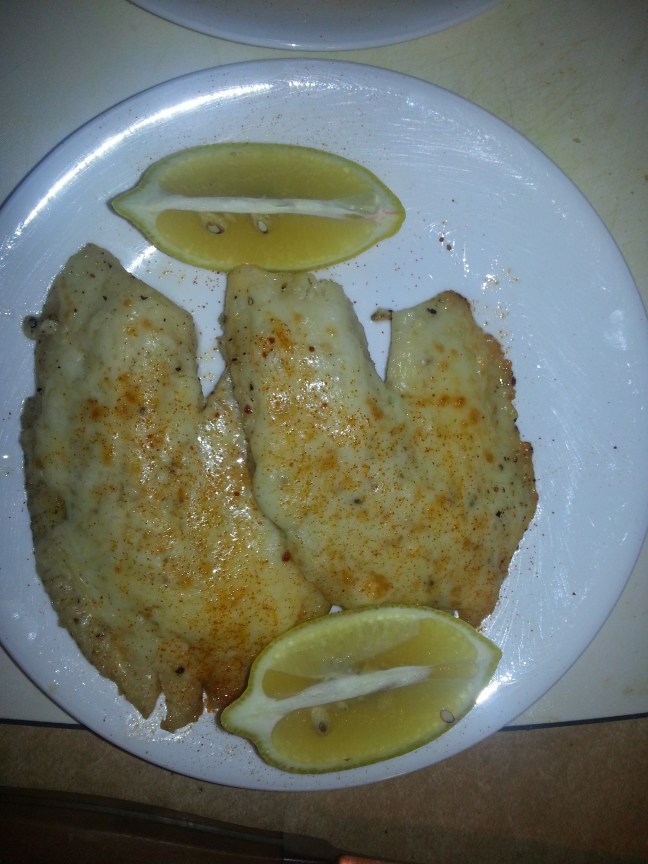
Parmesan Tilapia

This is a super simple recipe that falls square into Phase III.  It takes a little practice but keep in mind that tilapia is a very forgiving fish and parmesan is a very forgiving cheese.

Ingredients

1.  24oz of tilapia, thawed rinsed and pat dried

2.  8oz of shredded parmesan cheese

3.  1 teaspoon each of salt, pepper, dried basil, garlic powder and onion powder

Recipe

1.  Liberally salt every piece of fish with the spice mixture.  Do both sides else it will end up bland.

2.  Bake the tilapia in a broilable pan/sheet at 325 for about 15 minutes or until the flesh is between translucent and white.  It will not be finished.

3.  I suggest draining any liquid off the pan.  Place all the cheese on the fish.  If you have 3oz filets, then you should have about 2oz for each filet.

4.  Turn the oven to broil and give it about 1 minute to get to temperature.  Put the fish in.  This is something that gets tricky, but gets better with experience.  It generally only takes about 90 seconds under the broiler to get the cheese all melty and awesome.  I usually pull it out and rotate the pan 180 degrees to get the most even meltiness.

5.  Pull it out and put a couple of lemon wedges with and yummy.

Herb’d Turkey with Sweet Potatoes

Ingredients

1.  1lb of ground turkey (the leaner the better, you are trying to be healthy!)

2.  1 tablespoon each of dried basil, parsley, thyme, marjoram and chives.

3.  2 – 1/2 teaspoons each of salt and pepper (4 1/2 teaspoons total smartypants)

4.  4 sorta medium sweet potatoes, washed, peeled and cut into 3/4 inch chunks.

5.  1 teaspoon olive oil

6.  1 cup vegetable broth

7.  1/8 cup shredded parmesan cheese

Recipe

1.  Take the ground turkey, all the spices and 1 each teaspoon of salt and pepper and put into a bowl and knead like you were making bread.

2.  When it is really well mixed, put it into a pan and cook it, stirring often.  You are looking for an appearance similar to breakfast sausage when you don’t make it into patty’s.  Just a bunch of loose meat really.

3.  When it is fully cook, reduce the heat to medium-low, add vegetable broth, stir well and cover.

4.  Bowl the sweet potatoes until they are boiled.

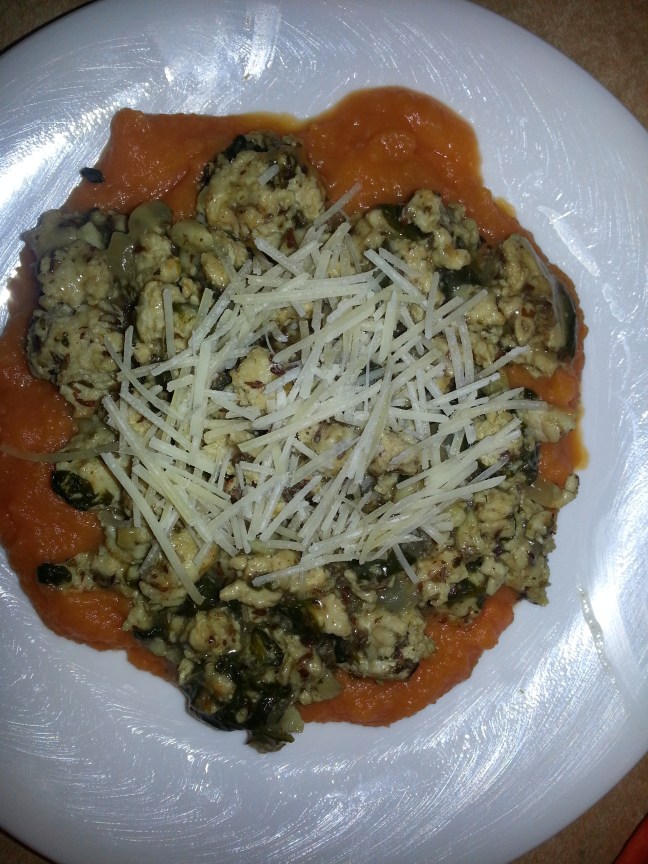
5.  Your choice here, the picture is of a sweet potato mash.  You can make it as lumpy or smooth as you want.  It’s your world.  It’s really about how much of the water you boiled it in do you add to it to get the consistency correct.

6.  Put roughly 1/4 of it onto a plate.  Should be about 4 ounces or so.

7.  Measure out 4 ounces of the turkey mixture, put on sweet potatoes.  Then spoon out 2 tablespoons of the brothy goodness and put it on top of that.

8.  Put the shredded cheese on top of that.

Its pretty yummy and a great dish for phase II people.  It is also infinitely changeable.  Substitute cilantro, coriander, cumin and dried chiles for the spices in the same ratio and you got something a little different.  Experiment and let me know what you think.


Preparation is the Key to Success!

Tips for getting ready for a week of Health and Wellness in your daily life.

  1. Buy lots of fresh vegetables.  And I mean lots of vegetables, the amount of vegetables you will eat is immense.  There is not a single wellness diet in the world, with any credibility, that does not require the egregious consumption of large amounts of vegetables.  This being said, most people cannot eat 142rutabagas in a week, so use your head.  In our life, this is our typical load of stuff that we get for ourselves:
    1. 5lbs of whole carrots
    2. 2 bunches of celery
    3. 5lbs of onions
    4. 2lbs of sweet potatoes
    5. 6-8 cucumbers
    6. 5lbs of fresh spinach
    7. 5 or so different squash (spaghetti, acorn, delicata, butternut)
    8. 1 stalk of Brussel sprouts
    9. 2lbs of grape tomatoes (fruits, yes, but for our purposes, they go in this list).
    10. 2-3 packages of fresh herbs
    11. 1 big bunch of broccoli
    12. 1 big bunch of cauliflower
    13. 3-4 other random items
  2. Buy lots of fresh fruit, but less fruit than vegetables. Keep in mind, that eating large amounts of fruit, while not altogether bad for you, will defeat the purpose of this particular diet in that your glycemic index will fluctuate a great deal more.  In all reality, you need to limit the amount of fruit you eat to about 3-4 servings per day.  Here is typically what we get for ourselves:
    1. 5-6 apples
    2. 1-2 bunches of bananas
    3. 5-6 oranges
    4. 2lbs of whole dates
    5. 2-3lbs of strawberries
    6. 3-5 random fruits depending upon season.
  3. Now, you that you have bought all of this stuff, you need to prep it. I would recommend getting some good music and doing as much of it at once as possible.  Prep all of the stuff that would be more convenient to use during the week.
    1. Carrots > peeled and cut into sticks. This will let you either eat them or cut them in to cooking pieces.
    2. Celery > peeled and cut into sticks. This will let you either eat them or cut them in to cooking pieces.
    3. Cucumbers > Peel and halve. Don’t go further than this.
    4. Brussel Sprouts > take off the stalk, wash, halve.
    5. Strawberries > core, meaning take the stalk out and remove the stem.
    6. Broccoli > cut all the florets off of the stem. Break into bite size florets.  Peel the stem, cut into ¼ to ½ inch chips.  Seems weird, but you can easily get addicted to this.
    7. Cauliflower > Couple of things here. Depending upon what you are going to do with your cauliflower dictates how you prep it.  Too much to go into here, search cauliflower on our site to get more info.
  4. Package all of this stuff in 1 cup servings. For instance, you will have a lot of baggies in the fridge when you are done.  I mean, a lot of baggies.  This way, when you make your lunch, you reach in grab 1 baggie for each 3-4 hour section you will be gone.  8-hour-shift = 3-4 baggies.  Now this is not an exact science here.  Don’t weigh it out or anything, guesstimate.  Guesstimate on the higher side will be better.  Put all of the stuff that does not “fit”, like say you have 1 carrot, 1 cucumber, 3 radishes, 2 mini celery stalks left.  Guess what, chop it up and put it on a salad.
  5. Package dressings into to go packages as well. Depending upon your diet and where you are in the LTL plan, you need to be careful here.  Keep an eye on the ingredients here because it’s easy to get out of hand.  Typically, package about 1/3 cup of something as a dressing to use either on salads, dips or flavor.
  6. Like #5, be careful here as well. Bake off 3 or so pounds of chicken and cut into strips and package into either 2 or 4 ounce servings.  The strips will go well on salads, alone or great into the dips you packaged for #4.
  7. Make 2 extra adult servings of everything you make and immediately package for the next day. Food will keep for about 5 days or so in the fridge.  There will be days when you are too busy to do anything at all and need some quick meals available.  There you go.  If you are on day 4 and have not eaten yet, then take out and freeze.  Majority of dishes, when there is not preservatives or high levels of fats, will freeze well.  The texture will be different, but you would be surprised how things are when you freeze them.  Plus, keep in mind, veggies require coolness to keep well in a lunchbox.  If you grab a frozen dish for your lunch, then it will keep everything cool.
  8. Date everything you prep!! Date everything you prep!! See above point for the main reason.  But you will have a great piece of mind.

Weeks 3 & 4

There have been limited updates about my particular journey to this ordeal and how it is going for me.  The only excuse that I have is that I am a student getting my BSN, working full-time as a new ICU-Nurse and all that comes with that, and balancing all of this sometimes means that I may go a couple of days (fine, a week) without posting things.

Here is where I am at:

After four weeks I am:         ↓  20.1lbs

                                              ↓  6”

                                              ↓  1.2% BFP

                                              ↑  3.1 H2O %

Now, I will be the first to admit that my weight loss has slowed down and that the best metric may be to go with the inches lost.  It seems to me that I have had a hard time putting out a goal for this number.  I thought about 20” as a goal so that is what I am deciding to go with.  I may hit that sooner that the 12 weeks is up, and if so, then hey, great!  I can always add it later.

I have been adding in some exercise and will be starting my calisthenics challenge to myself in the beginning of week 7, after we take our week 6 pictures.  I will definitely post my  week before and after pictures here on the blog, and am debating whether or not I will be posting on Facebook.  But, more to come, and I am going to start focusing energy on the cook book that I want to put out quarterly in electronic format.  I will be charging for it, but we are deciding on a price point probably between $2.95 and $4.95.  Please let me know what you think.

We are also going to be opening things up to contributors.  We are going to limit the contributions to original pieces and probably specifically people who are going through or have gone through the same program that we are.  That will come later.

As always, please let me know what you think and contact me directly or comment here.


Herb Chicken with Lemon Veggie Puree

Ingredients

1.  16oz of chicken

2.  2 cups each of chopped carrots, celery, onion

3.  4 cloves of garlic

4.  1/2 cup fresh squeezed lemon juice and vegetable broth

5.  1 teaspoon each of salt, pepper, dried lemon peel.

6.  1 teaspoon each of salt, pepper, dried oregano, dried basil, dried lemon peel

7.  1 teaspoon olive oil

8.  1 teaspoon rice wine vinegar

9.  1 teaspoon dried chives (for garnish and flavor)

Recipe

1.  Rinse and wash your chicken then pat very dry

2.  Rub the chicken with the olive oil (yes there is enough)

3.  Cover in spice mix from #6

4.  Bake in 375 degree oven for roughly 30 minutes (till its done, all ovens are different, relax, chicken is very forgiving when its rubbed with oil and spices)

5.  Combine all veggies, vinegar, lemon juice, vegetable broth and remining spices in a pan and sweat.  Over the next 20 minutes or so, there should end up being some decent amount of liquid.

6.  Take a hand-mixer to it till its what professionals call a “puree”.  Your are looking for a texture sort of like loose mashed potatoes or even grits.  Chunks will not alter the flavor, but you want it well combined.

This recipe will divide up into approximately 4 servings (we ate 2 for dinner, then took the other 2 for work lunches, yes they microwave well).  At the end, you have 4 ounces of chicken, and about 1-1/2 cups of veggies.  Its pretty yummy.

Parmigiano Reggiano

Let’s talk about cheese.  Specifically a very common cheese with lots of benefits and is probably in your fridge or shelf right this moment.  Parmesan.  I could say Parmigiano Reggiano, but I am not fancy so this distinction is not necessary for this.  First, the benefits:

Protein

Your body uses protein to repair and maintain itself. It is a major part of nearly every tissue in your body.  Protein in your blood is one of the things that keeps you hemodynamically stable.  And at times, when you are having fluid imbalances, the solution is to add protein you in the form of IV protein.  A 2-ounce serving of Parmesan cheese contains roughly 20 grams of protein, which can be as high as 41 percent of the daily value, set by the U.S. Food and Drug Administration and based on a 2,000-calorie diet.  Now, 2 ounces of parmesan is roughly 4 tablespoons, keep that in mind when you look at recipes.

Calcium

An article published in the journal, “Clinical Cases in Mineral and Bone Metabolism” in September 2011 notes that numerous studies have established that dietary calcium, along with protein and vitamin D, are essential for achieving peak bone mass and maintaining bone health. Parmesan cheese is easily digested and an excellent source of calcium with a 2-ounce portion containing 671 milligrams, which is more than 67 percent of the DV for this mineral. This cheese also contains small amounts of vitamin D.1

Vitamin A

Vitamin A aids in good vision, particularly in lowered light during the low light periods near sundown.  Sufficient vitamin A also contributes to healthy skin, teeth and body tissue. A 2-ounce serving of Parmesan cheese provides 443IU of vitamin A, which is about 9 percent of the DV

Miscellaneous

Consider this – Parmesan Cheese contains all the goodness of the milk it came from but in a concentrated form.  Approximately 3 gallons of milk are required to make 1 pound of parmesan cheese.  Due to its long ageing, much of the protein in Parmesan has been broken down into peptones, peptides and free amino acids, in effect the protein has been ‘pre-digested’; the protein is readily available and as such it puts very little strain on the metabolism.  Parmesan contains 33% protein compared to 20% in lean beef and that animal protein takes 4 hours to digest while the protein in Parmesan takes just 45 minutes. Other benefits to the digestion include Parmesan’s ability to promote the development of Bacillus Bifidus, which is useful for the maintenance of a healthy gut, and also the fact that there is no lactose present – good news for the lactose intolerant or those with gastrointestinal inflammation.

Nothing is perfect, here are the downsides:

Sodium

A 2-ounce serving of Parmesan cheese contains 780 milligrams of sodium, which is 32.5 percent of the DV.  If you are age 51 or older, African-American, or have high blood pressure, diabetes or chronic kidney disease, you should limit your sodium intake to 1,500 milligrams per day.

Fat

The fat content of cheese often causes alarm to the health conscious but it is important to note that fat is a fundamental part of nutrition. Muscular activity is dependent on fatty acids and, again, because of the changes that occur during the ageing of Parmesan, much of the fat is in the form of short-chain fatty acids, these compounds are absorbed more easily and supply energy very quickly to the body; in fact, they are treated by the body in much the same way as glucosides (sugar). The cholesterol content of Parmesan is only 80 – 85mg/100g, much lower than other full fat cheeses. Exponents of preventative medicine take an unfavorable view of this cholesterol but a daily intake of 300mg is beneficial according to health guidelines so cholesterol should not be seen as a limiting factor in the consumption of Parmesan.

This combination of nutritional benefits explains why in Italy doctors recommend Parmesan to infants and the elderly as well as to athletes.


  1. Pampaloni, B., Bartolini, E., & Brandi, M. (2011). Parmigiano Reggiano cheese and bone health.Clinical Cases in Mineral and Bone Metabolism, VIII(3), 33-36.



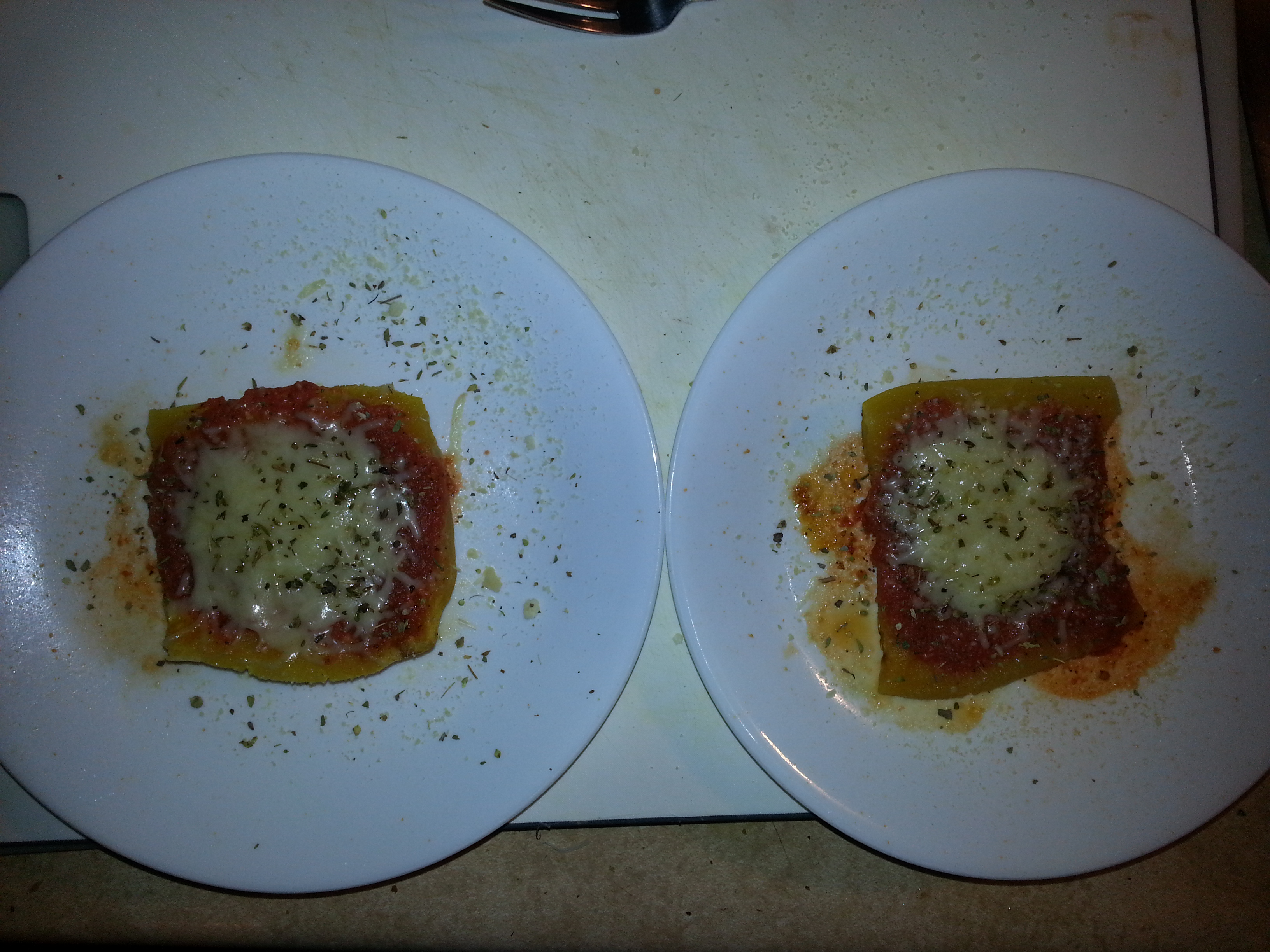
Squash Pizza

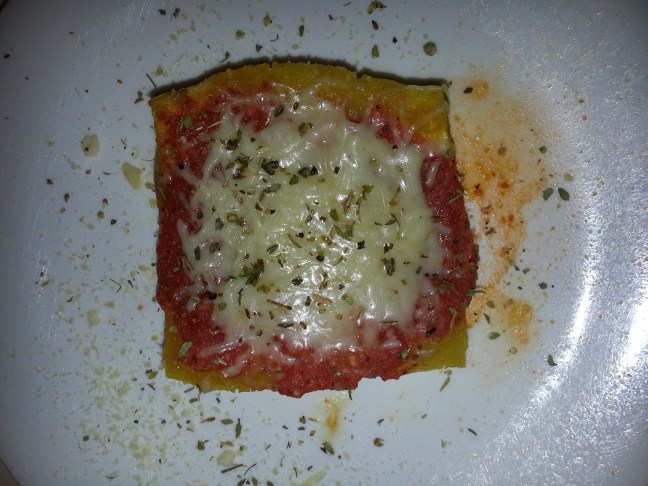
Holy Crap was this easy and awesome.

Ingredients

1.  One Delicata squash, peeled, halved and seeded.

2.  2×1/2 cup of clean pizza sauce (14 oz drained and rinsed canned tomatoes, 1 teaspoon dried thyme, 1 teaspoon dried oregano,  1 teaspoon salt, 1 teaspoon pepper, 1 teaspoon of olive oil, pureed with a hand mixer, yummy, will keep for about 1 week in this form, won’t last that long though)

3.  2×1 tablespoon grated parmesan cheese

4.  2×1 tablespoon shredded parmesan cheese

5. 2×1/2 teaspoon dried oregano

Recipe

1.  Bake the delicata squash at 400 degrees for about 12-18 minutes, until easily pierced with a fork.

2.  Remove from oven and turn on the broiler.

3.  Cover the squash with the grated parmesan cheese

4.  Pour 1/2 cup clean pizza sauce, trying to keep all or most of it in the squash cavity

5. Cover with the shredded cheese

6.  Put in the broiler until the cheese melts.  Bubbly cheese would be better, but really really high risk of burning it.  Shouldn’t take more than 2 minutes,

7.  Take out and sprinkle the oregano over the whole thing as a garnish and for flavor.

8.  You may or may not need salt, depending upon your taste.  I suggest putting it on before baking if you want it to be salty.

9.  Enjoy and tell your friends.

squash pizza 1 squash pizza 2


Parchment Tilapia with Lemon Garlic Zucchini

Ingredients

1.  16 oz (around 4 filets) of wild tilapia

2.  2 large sheets of parchment paper

3.  1 whole lemon, sliced thin into 16 sections

4.  24 fresh basil leaves (4 x 6 leaves)

5.  4 scallions, cut into 4 equal stacks of 1/2″ sections

6.  4 teaspoon each of salt, pepper, white wine vinegar (separated out in sets of 4)

Recipe

1.  Wash your fish and pat dry (you may not think its necessary, but really did the guy who packed it up in wherever actually wash his hands)

2.  Lay 2 lemon slices down on parchment, a bit off-center to one side or the other.

3.  Lay 1 filet on top

4.  Put salt and pepper on top of the fish

5.  Loosely cover with 1 stack of scallions

6.  Place 6 basil leaves over the fish

7.  Place 2 lemon slices on top of fish

8.  Cover in 1` teaspoon white wine vinegar.

8. Repeat this process about 1 inch away on the same sheet of parchment, closer to the edge

9.  Not moving the fish, fold the parchment over and crimp the sides, I stapled them to keep them shut.

10.  Put into an oven that you preheated to 375 degrees sometime either before hand, or wait 10 minutes for it to heat up.

11.  Cut your Zucchini into 1/2″ sections (we used baby zucchini)

12.  Saute on medium with a little olive oil and as much minced garlic as you like (I used about 2 tablespoons in the whole pan).

13.  Fish will take about 12-14 minutes to cook/steam altogether.  If you do it right, your zucchini should be done at the same time that you take out your fish.

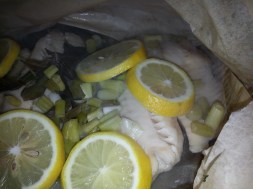
14.  Fish removal means simply cutting open your bag with scissors and taking it carefully out of the bag.  I do not recommend eating the basil or the scallions as it will taste similarly to cat vomit mixed with old salad.  In the picture above, there is about 1 lemon wedge per fish, but Emily used 2 per fish.  This was good.  It is light and it is tasty.  If you want more salt (I am a notoriously undersalter) then salt to taste.

inside bag tilapia